Before America Faces Its Own Staple-Crop Reckoning, It Should Study Japan's Rice Problem
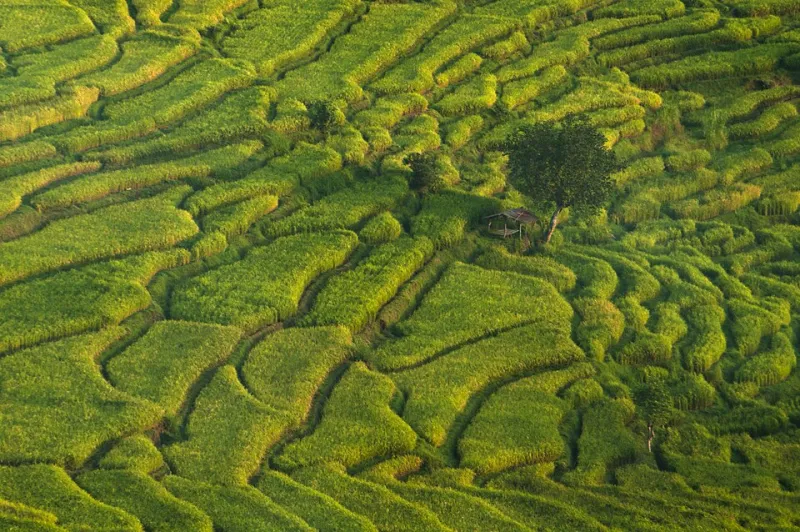
Photo: Dionbagindo, CC BY-SA 4.0, via Wikimedia Commons
For most of the past half-century, rice in Japan was boring. Stable prices, stable supply, a staple so dependable it functioned as a unit of cultural accounting. Then, beginning in 2023 and reaching a crisis pitch through 2024 and 2025, rice prices in Japan surged to levels unseen in half a century—driven by poor harvests, a sharp tourism-driven demand increase, policy-managed production limits, and a distribution system with little slack. Rice, the most protected commodity in Japanese agriculture, became the most visibly scarce item on Japanese shelves.
American readers should resist the temptation to file this under foreign curiosities. What happened to Japanese rice is a preview of a failure mode that American food supply chains are quietly building toward, and the policy response in Tokyo—stockpile releases, subsidy band-aids, renewed protectionist rhetoric—offers a case study in what not to do when the reckoning arrives.
Resilience Theater, Defined
Call it resilience theater: the collection of policies that look like supply security while systematically hollowing it out. Japan's rice regime is a masterclass in the genre.
For decades, Japanese rice policy rested on three pillars: production adjustment (paying farmers to grow less), high tariffs that priced out foreign competition, and a political commitment to keeping farm households viable regardless of efficiency. Each pillar was defensible in isolation. Together, they produced a domestic industry optimized not for resilience but for managed scarcity—a system with few alternative suppliers, thin commercial stockpiles relative to true crisis needs, and a consumer base with no exposure to price signals that might have driven diversification.
When the shocks came—a bad harvest year layered on top of record inbound tourism and a distribution sector running just-in-time margins—the system had nowhere to flex. Prices doubled. The government released reserve rice, then re-released it, then restructured the release mechanism when the first attempt failed to move retail prices. Subsidies followed. Each intervention treated the symptom while leaving the underlying architecture—concentration without redundancy—fully intact.
This is the signature of resilience theater: enormous policy energy devoted to restoring the appearance of stability, minimal energy devoted to building actual adaptive capacity.
The American Mirror
It would be comfortable to assume that America's commodity abundance makes this a Japanese problem. The comfort would be misplaced.
US staple production is extraordinarily efficient—and extraordinarily concentrated. A handful of states dominate corn, soy, and wheat output. Processing capacity in meat and grain has consolidated into a small number of corporate chokepoints. Fresh produce supply leans heavily on a small number of import corridors, notably through California and Mexico, both of which face their own water and climate stress. The American food system is not fragile the way Japan's is, but it is fragile in a complementary way: optimized for cost at global scale, with redundancy treated as an expense to be engineered out.
Add the current policy environment—tariff uncertainty with trading partners, immigration enforcement tightening the agricultural labor supply, and climate volatility arriving faster than breeding cycles can adapt—and the parallel becomes harder to wave away. A single bad season in one or two concentrated regions, interacting with a chokepoint in processing or transport, could produce a staple-price shock that American consumers, accustomed to the cheapest food supply in the developed world, would experience as a betrayal.
The question is whether US policymakers and food executives would respond by building adaptive capacity or by performing it.
Three Lessons Worth Importing
Japan's experience, read honestly, offers three usable lessons.
First, distinguish stockpiles from resilience. Japan's reserve rice program looked like a buffer; in practice it was a political instrument whose release rules were designed for market management, not crisis response, and its deployment failed to calm retail prices. Resilience is not what you store—it is how many genuinely independent supply paths you can activate under stress. For American food executives, that means stress-testing alternate processing capacity, alternate logistics corridors, and alternate sourcing geographies before the crisis, not during it.
Second, subsidies delay reckoning; they do not prevent it. Japan's production-adjustment payments and emergency supports kept the system politically stable for decades while it grew structurally rigid. The eventual adjustment, when it came, was harsher because it had been postponed. US agriculture policy, with its own deep subsidy architecture, should take note: every dollar that insulates a producer from price signals is a dollar that defers adaptation.
Third, diversify before you need to. Japan's tariff wall made foreign rice a non-factor in the domestic market, which meant that when domestic supply wobbled, there was no commercial import infrastructure to lean on—relationships, logistics, and consumer acceptance all had to be built mid-crisis. The American analog is import concentration and regional monoculture. Building even modest alternative supply paths—secondary origins, secondary processors, secondary transport routes—is cheap in peacetime and priceless otherwise.
The Uncomfortable Conclusion
The deepest lesson from Japan's rice shock is not about agriculture at all. It is about the difference between systems that are stable because they are resilient and systems that are stable because nothing has gone wrong yet. Japan's rice regime was the latter, and the illusion held for fifty years.
American food supply chains are, by most measures, the best in the world. That is exactly why they are vulnerable to the same illusion. Resilience theater is most persuasive in the countries that can least afford it—the ones whose efficiency has never been seriously tested. The time to find out which kind of stability you have is before the harvest fails, not after.